Introducing: Lineage for Financial Services
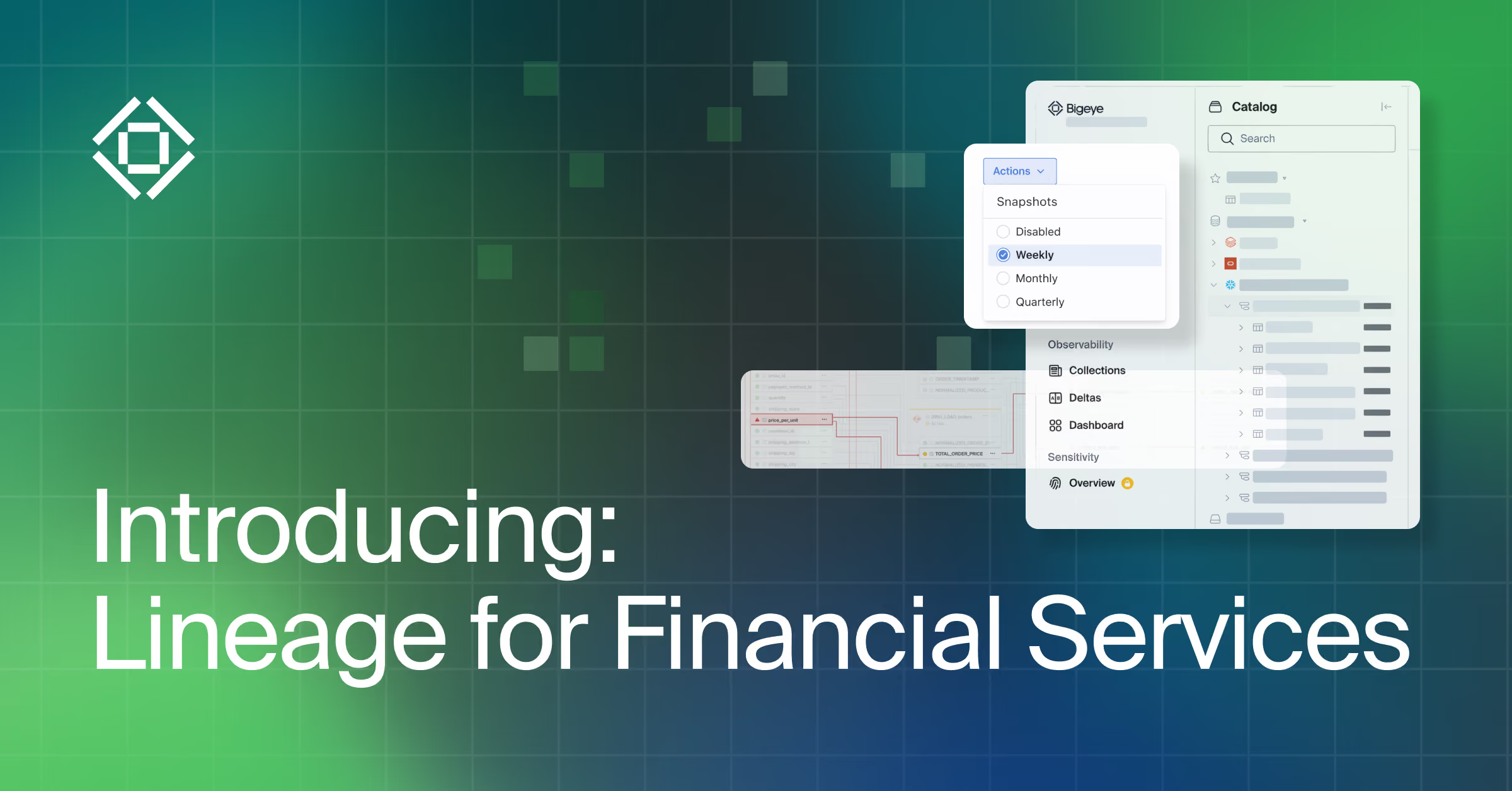
Bigeye is extending its existing end-to-end, column-level lineage with purpose-built capabilities for financial services compliance teams. With point-in-time lineage, scoped filtering, and exportable audit-ready views, institutions can turn lineage into defensible evidence aligned to frameworks like BCBS 239, DORA, and GDPR, without manual reconstruction or unnecessary system exposure.
.avif)
Get the Best of Data Leadership
Stay Informed
Get Data Insights Delivered
Financial services compliance teams operate in a world where evidence matters more than intent.
When regulators ask questions, they are not looking for diagrams or high-level explanations. They want to see exactly where critical reporting or risk data originated, how it changed, where it moved, and who had access to it during a specific reporting period. For many institutions, answering those questions still means screenshots, spreadsheets, internal coordination, and manual lineage reconstruction.
That is the problem we set out to solve.
Today we are launching Bigeye Lineage for Financial Services, a purpose-built extension of our existing platform designed to turn lineage into defensible, repeatable audit evidence for financial institutions.
Bigeye already delivers end-to-end, column-level lineage across warehouses, ETL systems, BI tools, and hybrid data environments. Organizations can trace a field from its origin through every transformation to its final destination. That level of visibility is foundational for modern data teams.
Compliance, however, introduces a different set of requirements.
An audit is not just about viewing lineage. It is about presenting it in a way that is time-bound, scoped, and defensible.
Compliance teams must respond to specific requests tied to defined reporting windows. They need to show what data flows looked like during that period, not only how systems are configured today. They must limit responses to the systems and datasets under review. They must avoid exposing unrelated or sensitive architecture. And they need to do this without repeatedly pulling data engineering into manual evidence gathering cycles.
Even with strong lineage capabilities in place, most institutions still rely on manual packaging. The lineage exists, but the workflow to convert it into audit-ready documentation often does not.
Lineage for Financial Services Compliance Teams builds directly on our column-level lineage foundation and adds the capabilities required to operationalize evidence creation.
A core requirement in financial services audits is point-in-time lineage. Regulators frequently require proof of how data moved and transformed during a specific reporting period. Bigeye enables teams to preserve lineage history and retrieve how data flowed at that exact point in time. Instead of reconstructing the past manually, teams can show what the environment looked like during the audit window.
Another challenge during audits is overexposure. In an effort to be transparent, organizations sometimes share more architectural detail than necessary. This can reveal unrelated systems and create additional scrutiny. At the same time, undersharing can trigger follow-up requests that extend the review process.
Bigeye supports controlled transparency. Compliance teams can filter lineage views to only the systems, datasets, and transformations in scope. Those views can be saved, shared, and exported as structured documentation to support audit workflows. The result is evidence that is precise, aligned to the request, and defensible.
Over time, this changes how audits are managed. Rather than rebuilding evidence for every review cycle, organizations can standardize how lineage outputs are generated and delivered. Manual effort decreases. Engineering interruptions are reduced. Consistency improves across audits and regulatory frameworks.
This is particularly important in financial services, where regulatory expectations are high and enforcement penalties tied to frameworks such as BCBS 239, DORA, and GDPR can reach into the millions. Institutions must be able to demonstrate clear control over how data moves into financial reporting and risk systems. That requires more than visibility. It requires evidence that is accurate, time-specific, and properly scoped.
Bigeye’s Lineage for Financial Services Compliance Teams is designed for compliance leaders who want audits to be structured and predictable rather than reactive.
If you would like to see how point-in-time, filterable, and exportable lineage can support your compliance program, you can learn more or request a demo.
Monitoring
Schema change detection
Lineage monitoring
Adrian Vidal