Get the Best of Data Leadership
Stay Informed
Get Data Insights Delivered
An analyst about to build a dashboard on an unfamiliar table usually runs a quick set of checks first. Is the table monitored? Does it have open issues? Has anyone classified its sensitive columns? Is it certified, and who owns it? The answers live in different places, so the analyst spends a few minutes and a message to the data owner, or skips the check.
An AI agent querying the same table has no equivalent step. It reads the rows and acts on them at machine speed, every time it runs, whether that's a one-off analysis or a report it refreshes each morning. Nothing in its context tells it whether anyone has monitored, classified, or certified the data underneath, or whether any of that has changed since its last run.
Context became the center of the agent conversation this year. In April 2026, Gartner advised data and analytics leaders to treat context as critical infrastructure and make the context layer the central "brain" for AI agents, with semantics and metadata as its core components. Most of the context work we see goes into meaning: glossary definitions, semantic models, and documentation that tell an agent what a column represents. Much less of it tells an agent whether that column is in a state to use right now.
An agent can know what a column means and still read it from a table nobody is watching
Picture an agent asked for last quarter's net revenue by region. A well-built context layer tells it which table holds net revenue, how the business defines it, and which join to use. None of that tells the agent the table's monitors stopped notifying anyone two months ago, or that most of its columns have never been scanned for sensitive data.
Those facts exist. They sit in observability, classification, and governance tools, mostly as dashboards and alerts built for people. Where those tools do summarize, they usually report a narrow slice, such as the share of quality rules or monitors that passed. Ownership, certification, and classification stay out of the number, and an agent has no way to request any of it before its next query.
Bigeye already collects the evidence agents are missing
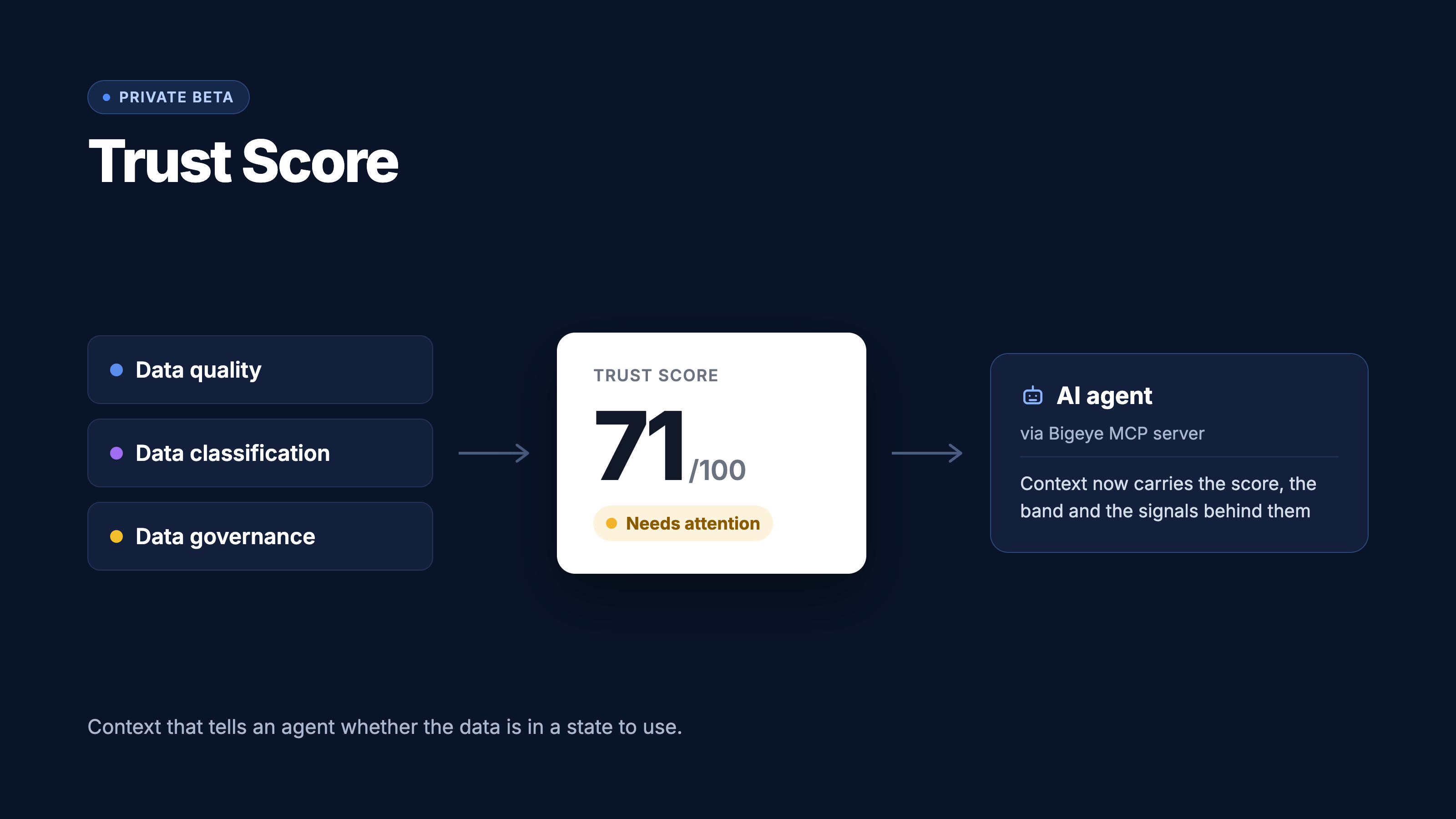
Data teams running Bigeye for data quality, observability, and governance already have most of this evidence on every connected asset: monitoring coverage, alert routing, sensitive-data scans, certification, ownership, glossary links, and critical data element tags. Until now, people consumed those signals individually. We built a Trust Score to put them to work as context. It's a weighted 0-100 score per asset, built from three signal categories with specific, countable sub-signals:
- Data quality and observability: The share of tables and columns with at least one monitor, and the share of monitors that send notifications
- Data classification: The share of columns scanned for sensitive data, and the share of scanned columns with a confirmed class
- Data governance: Whether the asset is certified, has an assigned owner, links to a glossary term, and carries a critical data element tag
By default, scores of 80-100 land in the Trusted band, 60-79 in Needs attention, and 0-59 in High risk. The score recalculates whenever an input changes, such as an issue opening or a table getting certified, and parent assets update with it.
People see the evidence on the Scorecard, and agents retrieve it through MCP
In Bigeye, a data consumer sees the score on each table's Scorecard: something like 71 out of 100, nine points short of Trusted, with a breakdown of which sub-signals cost points, such as a missing owner or unscanned columns. An agent retrieves the same object through Bigeye's MCP server before it reads, transforms, or acts on the data. Its context then carries the score, the band, and the signals behind them, next to the definitions it already has.
That changes how an agent can behave. An agent that knows a table sits in Needs attention because nobody owns it can say so, look for another source, or ask for review. One platform leader we spoke with described exactly this: he wanted an agent that could tell a user it can't answer right now because the data is below threshold, and he preferred that to an agent that gets shut off with no explanation.
Context informs the agent, and policy makes the call
The design choice we spent the most time on was where the score stops. Trust Score reports evidence. A policy, an orchestrator, or the agent's own reasoning decides what to do with it: allow the query, require human approval, or refuse.
A built-in allow-or-deny gate was the obvious first design. We dropped it once it was clear the right threshold depends on the task. A table that works for exploratory analysis can still need review before it feeds a customer-facing answer, and only the organization knows where that line sits. In Bigeye’s Policy Engine, a team writes that line as a rule translating policy as code:
IF trust_score >= 80 AND the asset has no open critical issue THEN allow
IF band = High risk THEN require approval
Admins decide which signals count toward trust
Organizations define trust differently. A bank with strict certification requirements can raise the governance weight, while a team early in its governance program can lean on monitoring. When an admin changes one weight, the others rebalance so the total stays at 100. A category that's switched off drops out of the calculation entirely, and the remaining weights rebalance to cover it.
Splitting each category into sub-signals came from a specific failure case. Picture a table with 50 columns where only two have been scanned, and both carry a confirmed class. As a simple ratio, that table's classification looks perfect. Under the default weights, Trust Score gives it full credit for the classified share and almost none for scan coverage, so classification contributes about half its 20 points. The score reflects how much of the table anyone has actually examined.
We also learned that a visible method is what makes a score useful in front of leadership. A data platform team at a large technology company had built its own internal quality score before we started on ours. When they presented 72% to management, they expected pushback on methodology. The questions came, and the conversation turned quickly to which gaps to close first. Governance leads can use the Trust Score breakdown the same way: find the cheapest points to recover, such as assigning owners or certifying the tables agents query most, and show the score moving. In the Agent Trust Hub, they can also sort agents by the Trust Score of the data each one accesses.
A governance leader at a mortgage lender took the agent view further. Their team wanted a score for each agent, built from the trustworthiness of the data it accesses, with drill-down to the tables behind it. For a regulated lender, that becomes a number leadership can track quarter over quarter and report to a risk committee or board.
A consistent scoring methodology also creates a basis for benchmarking. Trust Score gives organizations a common measure of data trust, making it possible to benchmark readiness across their data estate, identify gaps, and measure progress as they prepare their data for AI. Teams can compare trust across tables, domains, and agents, prioritize remediation, and track whether investments in data quality and governance are translating into measurable improvements.
What the score can't tell an agent yet
A Trust Score measures how much evidence exists that an asset is monitored, classified, and governed. It doesn't estimate the probability that a given row is correct, and a Trusted band on its own doesn't authorize every task. The default weights are a starting point. We're collecting data on how scores line up with incidents that happen later, and we won't claim the score predicts failures until that analysis supports it.
The question we're watching most closely is whether High risk assets produce measurably more incidents than Trusted ones, and how much that answer varies with each organization's weights.
For data leaders building a context layer this year, the practical test is whether it carries the condition of the data along with its meaning.
As organizations move from experimenting with AI agents to connecting them to production data, context needs to evolve beyond definitions and documentation. Agents need to understand not just what data means, but whether it is monitored, classified, governed, and appropriate for the task at hand.
Trust Score brings those signals into the context layer, giving agents and the systems that govern them a more complete picture of the data they're using.
Because trustworthy AI starts with more than understanding the data. It starts with understanding whether the data can be trusted.
Trust Score is open to a group of early-access customers now. If your team is starting to connect agents to production data, we'd be glad to walk through it on your own tables.
Monitoring
Schema change detection
Lineage monitoring

Shane Wiggins