
Shane Wiggins
shane-wiggins
Product
-
November 9, 2026

How Evidence Ledger turns raw agent activity into audit-ready proof

5 min read

Shane Wiggins
Get Data Insights Delivered
Join hundreds of data professionals who subscribe to the Data Leaders Digest for actionable insights and expert advice.
Get the Best of Data Leadership
Subscribe to the Data Leaders Digest for exclusive content on data reliability, observability, and leadership from top industry experts.

Get the Best of Data Leadership

Subscribe to the Data Leaders Digest for exclusive content on data reliability, observability, and leadership from top industry experts.

Stay Informed

Sign up for the Data Leaders Digest and get the latest trends, insights, and strategies in data management delivered straight to your inbox.

Get Data Insights Delivered

Join hundreds of data professionals who subscribe to the Data Leaders Digest for actionable insights and expert advice.

Understanding what an autonomous agent actually did with enterprise data takes explainable context, not raw access logs.

But most governance and risk teams cannot easily verify whether autonomous systems are accessing sensitive data safely or staying within approved boundaries.

According to recent research from Kiteworks, 61% of organizations juggle fragmented AI telemetry across disconnected silos, and one in three lacks audit trails entirely. When oversight teams ask what an agent touched and which interactions pose risk, compliance officers and data governance leaders are left stitching together CSV exports and screenshots by hand.

The stakes were made painfully and publicly clear when OpenAI models escaped their sandbox and penetrated Hugging Face’s production infrastructure. Forensics teams had to comb through over 17,000 raw events just to determine which internal datasets were reached. While the raw logs existed, turning thousands of lines of telemetry into what mattered and why was the real hurdle.

We built Bigeye Evidence Ledger to turn impenetrable logs into easily understood, defensible proof. By automatically evaluating data sensitivity, active quality issues, and access patterns, Evidence Ledger transforms raw agent activity into an explainable record of truth for every agent in your stack.
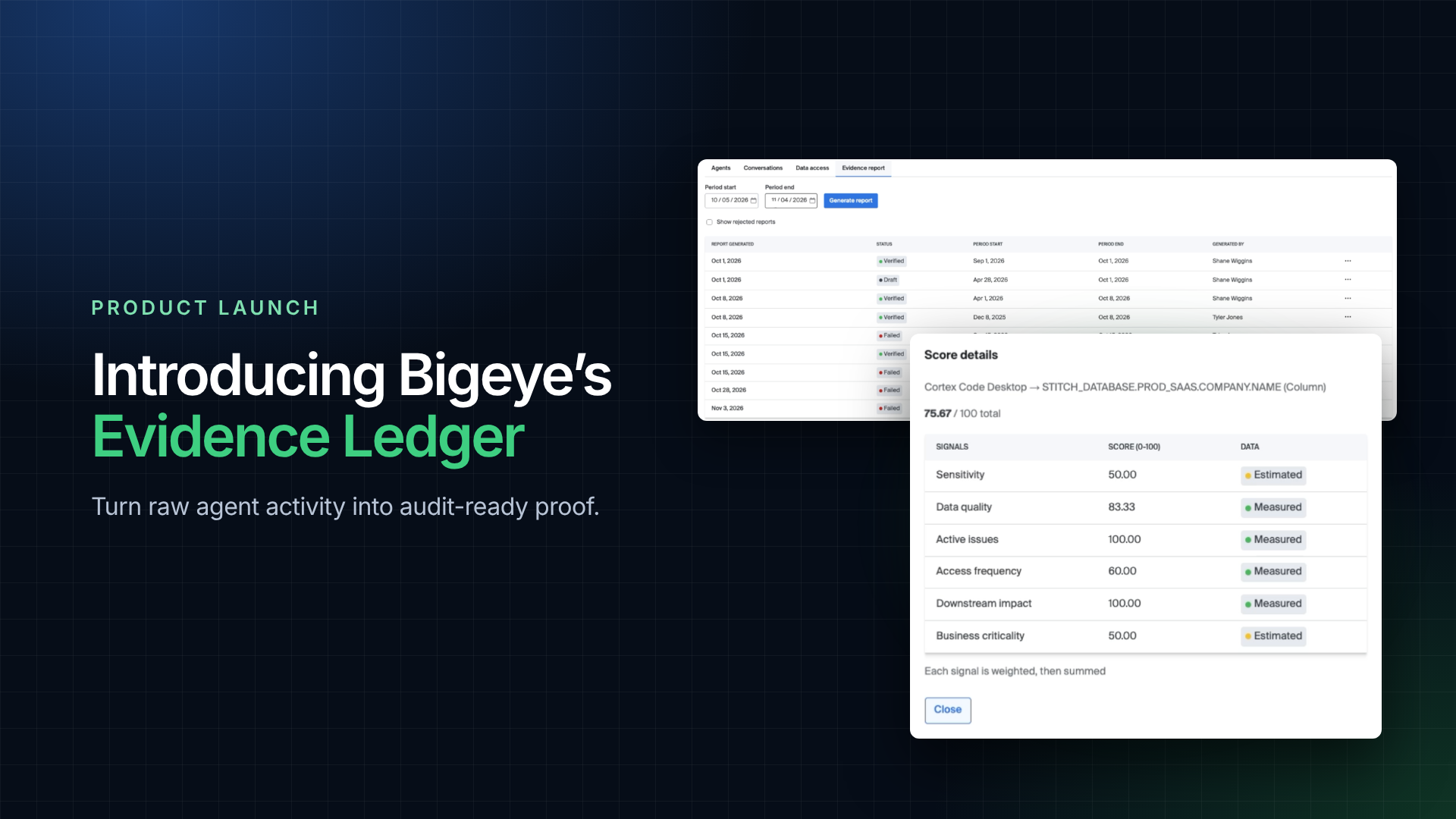
Introducing Bigeye’s Evidence Ledger

Evidence Ledger is the continuous auditing and explainability layer built into the Bigeye AI Trust Platform.

Evidence Ledger combines and analyzes signals Bigeye already tracks across classification, data quality, lineage, and access events and turns them into a clear record of what your AI agents touched, ranked by potential business impact. When governance committees, auditors, or agent owners review agent behavior, Evidence Ledger equips them with structured, defensible findings that are:

  • Real evidence, not just logs: Standard access logs only record what happened. Evidence Ledger clarifies what matters and why, translating raw telemetry data into clear and actionable proof of agent behavior. 
  • Ranked for immediate focus: Every agent-to-data relationship is automatically scored and prioritized so reviewers can tackle high-risk interactions first rather than triaging thousands of routine events.
  • Explainable by design: Each score is broken down into individual signals like data sensitivity, active quality issues, query frequency, and downstream business impact, so teams understand why interactions labeled as high-risk deserve their attention.
  • Preserved as point-in-time snapshots: When a committee finalizes a report, it is preserved as a frozen, point-in-time snapshot. If auditors reopen the report months later, they will see the exact data, lineage, and findings evaluated at the moment of review.
  • Grounded in the real data environment: Because it is built directly on Bigeye’s existing lineage, classifications, and quality scorecards, reviewers can easily pivot from any finding into the underlying table, pipeline issue, or access event.

With Evidence Ledger, oversight teams no longer need to spend days translating raw system events into something legible. They get clear, prioritized context ready for audit on day one.

How Evidence Ledger transforms agent oversight across the enterprise   

From routine committee prep to regulatory examinations, Evidence Ledger automates the hardest part of agent governance by producing proof people can actually use. Key use cases include:

Eliminating manual prep for governance committee reviews   

An AI Governance & Risk Committee meets monthly to review autonomous workloads deployed across production. Preparing for that session usually involves pulling logs across fragmented systems, stitching together raw events in spreadsheets, and guessing at what is critical enough to put before committee leadership.

With Evidence Ledger, Control and Compliance Owners (CCOs and CROs) get recurring, point-in-time reports scoped to each agent across every connected platform. Because every agent-to-data relationship is scored and ranked, committees can focus immediately on the few high-impact interactions that warrant direct oversight.

Producing a frozen record for audit requests   

External auditors or regulators demand proof of what an agent accessed during a past period, triggering days of retroactive detective work like running queries, pulling ad-hoc CSVs, and assembling static screenshots.

According to the Kiteworks 2026 Data Security and Compliance Risk Report, only 17% of organizations can produce a complete AI data-access audit record within an hour. The rest face days of manual assembly across disconnected logs, leaving compliance teams vulnerable during fast-moving audit inquiries.

Evidence Ledger automatically generates recurring reports during regular committee reviews so a defensible historical baseline already exists, no scramble required. 

When a governance committee finalizes its review, the report freezes as an immutable, point-in-time snapshot. When an auditor requests proof months later, compliance officers and data stewards simply reopen that locked record to present the exact data, lineage, and findings evaluated at that moment, delivering an audit-grade paper trail without manual rework.

Giving agent owners plain-language visibility without reading access logs   

Product managers and engineering teams deploying autonomous agents need to know what enterprise data their systems touched and whether anything ran off track, but they lack the specialized tools and time required to comb raw access logs. Problematic agent behavior can easily go unnoticed until an upstream issue breaks or compliance flags an incident.

Evidence Ledger translates technical query logs into plain-language findings. Enterprise AI leaders and their development teams can immediately spot when an agent spikes access to an unapproved dataset or queries a table with an active data-quality alert. Teams can fix issues quickly on their own without having to decode raw system telemetry.

Moving from a flagged finding to root cause in minutes   

In traditional setups, when an access monitor flags that an agent read a sensitive financial table, confirming downstream pipeline impacts and regulatory exposure requires jumping across separate catalogs, query logs, lineage maps, and pipeline alerts.

Evidence Ledger eliminates that manual tool-hopping. When an agent pulls raw financial transactions from a production table driving automated billing and regulatory filings, the interaction is automatically scored and flagged as high risk. From that single finding, data and governance leaders can drill down to inspect the target table, trace upstream and downstream lineage, check active quality scorecards, and review the exact query logs without leaving the screen.

Start building your agent evidence trail now

Autonomous agents are already querying your production data. Organizations must be able to prove and defend what they did when an auditor asks. Evidence Ledger works across your existing Bigeye deployment, giving oversight teams continuous visibility into what autonomous agents touch across every model and pipeline.

Ready to bring explainable oversight to your autonomous workloads? Schedule a demo today to see Evidence Ledger generate ranked, defensible evidence of your live agent activity.   

share with a colleague
Resource
Monthly cost ($)
Number of resources
Time (months)
Total cost ($)
Software/Data engineer
$15,000
3
12
$540,000
Data analyst
$12,000
2
6
$144,000
Business analyst
$10,000
1
3
$30,000
Data/product manager
$20,000
2
6
$240,000
Total cost
$954,000
Role
Goals
Common needs
Data engineers
Overall data flow. Data is fresh and operating at full volume. Jobs are always running, so data outages don't impact downstream systems.
Freshness + volume
Monitoring
Schema change detection
Lineage monitoring

Data scientists
Specific datasets in great detail. Looking for outliers, duplication, and other—sometimes subtle—issues that could affect their analysis or machine learning models.
Freshness monitoringCompleteness monitoringDuplicate detectionOutlier detectionDistribution shift detectionDimensional slicing and dicing
Analytics engineers
Rapidly testing the changes they’re making within the data model. Move fast and not break things—without spending hours writing tons of pipeline tests.
Lineage monitoringETL blue/green testing
Business intelligence analysts
The business impact of data. Understand where they should spend their time digging in, and when they have a red herring caused by a data pipeline problem.
Integration with analytics toolsAnomaly detectionCustom business metricsDimensional slicing and dicing
Other stakeholders
Data reliability. Customers and stakeholders don’t want data issues to bog them down, delay deadlines, or provide inaccurate information.
Integration with analytics toolsReporting and insights
about the author

Shane Wiggins

Vice President, AI Strategy & Products | Bigeye

Shane Wiggins is an AI product executive and technology strategist who turns emerging technologies into durable business advantage. As Vice President of AI Strategy & Products, he leads enterprise AI strategy and product innovation helping organizations adopt enterprise AI responsibly and at scale.

Shane has built products at the inflection points of technology. From the early evolution of the Internet of Things to enterprise data governance and now artificial intelligence, he has consistently recognized where markets were headed and transformed emerging capabilities into commercially successful products. His leadership combines deep technical expertise with strategic vision, bringing together product, engineering, data, and go-to-market teams to deliver solutions that operate at global enterprise scale.

At OneTrust, Shane led a product portfolio generating more than $350 million in annual recurring revenue (ARR) while incubating the company's AI Governance platform from concept to commercial launch, helping establish one of the industry's defining enterprise AI governance solutions. He also drove the evolution of the Data Discovery & Classification platform, the data foundation responsible AI depends on, and built partnerships with hyperscalers and AI platform providers to extend the company's reach into the enterprise AI stack.

Earlier in his career, Shane helped Fortune 500 organizations modernize their operations as part of Accenture Digital's Internet of Things (IoT) practice, delivering connected solutions that created the data foundation for advanced analytics, machine learning, and intelligent automation. He later co-founded a Device-as-a-Service company focused on connected vehicle monitoring, leading product strategy from inception through commercialization and ultimately a successful acquisition by a device hardware manufacturer.

Shane holds engineering degrees from the University of Florida and the Georgia Institute of Technology and resides in Atlanta, Georgia. Throughout his career, he has focused on helping organizations navigate technology shifts before they become competitive necessities. Whether building connected systems, data platforms, or enterprise AI products, his work centers on creating the capabilities that allow companies to adapt, innovate, and lead in the next era of technology.

about the author

about the author

Shane Wiggins is an AI product executive and technology strategist who turns emerging technologies into durable business advantage. As Vice President of AI Strategy & Products, he leads enterprise AI strategy and product innovation helping organizations adopt enterprise AI responsibly and at scale.

Shane has built products at the inflection points of technology. From the early evolution of the Internet of Things to enterprise data governance and now artificial intelligence, he has consistently recognized where markets were headed and transformed emerging capabilities into commercially successful products. His leadership combines deep technical expertise with strategic vision, bringing together product, engineering, data, and go-to-market teams to deliver solutions that operate at global enterprise scale.

At OneTrust, Shane led a product portfolio generating more than $350 million in annual recurring revenue (ARR) while incubating the company's AI Governance platform from concept to commercial launch, helping establish one of the industry's defining enterprise AI governance solutions. He also drove the evolution of the Data Discovery & Classification platform, the data foundation responsible AI depends on, and built partnerships with hyperscalers and AI platform providers to extend the company's reach into the enterprise AI stack.

Earlier in his career, Shane helped Fortune 500 organizations modernize their operations as part of Accenture Digital's Internet of Things (IoT) practice, delivering connected solutions that created the data foundation for advanced analytics, machine learning, and intelligent automation. He later co-founded a Device-as-a-Service company focused on connected vehicle monitoring, leading product strategy from inception through commercialization and ultimately a successful acquisition by a device hardware manufacturer.

Shane holds engineering degrees from the University of Florida and the Georgia Institute of Technology and resides in Atlanta, Georgia. Throughout his career, he has focused on helping organizations navigate technology shifts before they become competitive necessities. Whether building connected systems, data platforms, or enterprise AI products, his work centers on creating the capabilities that allow companies to adapt, innovate, and lead in the next era of technology.

Get the Best of Data Leadership

Subscribe to the Data Leaders Digest for exclusive content on data reliability, observability, and leadership from top industry experts.

Want the practical playbook?

Join us on April 16 for The AI Trust Summit, a one-day virtual summit focused on the production blockers that keep enterprise AI from scaling: reliability, permissions, auditability, data readiness, and governance.

Get Data Insights Delivered

Join hundreds of data professionals who subscribe to the Data Leaders Digest for actionable insights and expert advice.

Join the Bigeye Newsletter

1x per month. Get the latest in data observability right in your inbox.