
Introducing Agent Trust Hub
TL;DR: Agent Trust Hub is a new product within the Bigeye AI Trust Platform that gives enterprises a connected view of AI agent activity across the tools and data platforms where work is already happening. It connects agent conversations and workflows to data quality, classification, lineage, ownership, policy, and cost signals so teams can understand what their agents are doing and whether those agents can be trusted to act. A 30-day free trial is available now with no waitlist and no sales call required.
.avif)
Get the Best of Data Leadership
Stay Informed
Get Data Insights Delivered
Enterprises that ran AI pilots last year are running AI systems this year. Agents are pulling from data warehouses, making recommendations, executing workflows, and sitting between customer requests and business decisions. That shift happened fast, and most organizations didn't build the observation layer before deploying the agents.
The result is a set of questions that teams can't yet answer with confidence: which agents are active in our environment? What data are they reading, and is that data accurate? Are sensitive fields being accessed? Who owns the underlying datasets? What policies apply, and are those policies being respected? What's the cost and risk profile of current agent usage?
Gartner's April 2026 research found that only 13% of organizations believe they have the right AI agent governance in place for the systems they're already running. The agents are in production. The ability to observe and manage them is still catching up.
Gartner's AI TRiSM framework (AI Trust, Risk and Security Management) gave enterprises a lifecycle model for governing AI: govern, map, measure, manage across design, development, deployment, and monitoring. It's a well-constructed framework. But it was built around models, not autonomous agents. An agent queries a data warehouse, interprets the results, and takes an action. It needs a trust layer that accounts for what it accessed, when, and whether that access was appropriate.
That's what Agent Trust Hub is designed to provide.
What Agent Trust Hub is
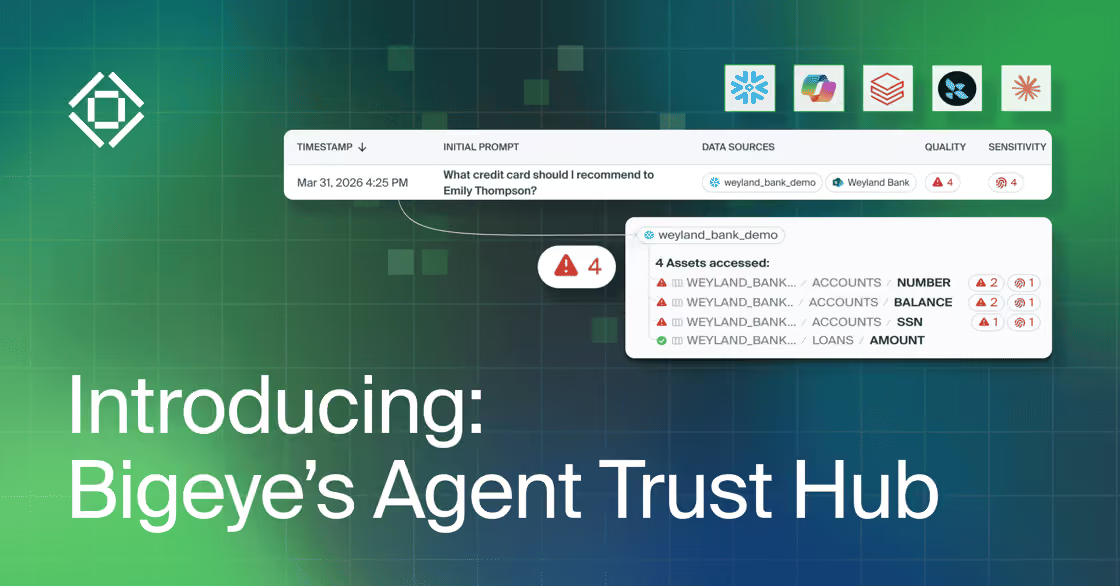
Agent Trust Hub is a new agent trust and activity hub within Bigeye's AI Trust Platform. It connects AI agent activity to the data trust signals that determine whether an agent's actions are reliable: data quality, data classification, data lineage, governance, ownership, policy, usage, and cost.
Rather than requiring teams to manually piece together agent activity from disconnected logs and dashboards, Agent Trust Hub brings those sources into one place. Teams can build a registry of agents, conversations, users, workflows, and data access events without adding a new set of integrations on top of existing work. For more on what an agent registry involves in practice, see what is an agent registry.
The hub connects to the agentic sources enterprises are already using. Current integrations include Snowflake Intelligence, Claude Code, and Databricks Genie. Microsoft Copilot and Salesforce Agentforce integrations are planned.
"AI agents are moving into workflows where revenue, customer experience, and business decisions are on the line," said Eleanor Treharne-Jones, Chief Executive Officer at Bigeye. "That raises the stakes for trust. Enterprises rolling out agents without visibility are accumulating risk they cannot yet quantify or govern. Organisations that invest in trust now will be operating with confidence at a point when others are still working out what their agents are doing."
How the Agent Trust Hub works
The core of Agent Trust Hub is the connection between agent activity and data context. When an agent pulls a dataset and acts on it, that action doesn't happen in isolation. The data has a freshness profile, a quality history, a classification status, an owner, and a set of policies that may govern how it should be used. Agent Trust Hub surfaces all of that, in the context of agent governance.
Specifically, teams can identify when an agent interaction involves:
- Stale data that may not reflect current business state
- Sensitive fields that require additional review or controls before use
- Known quality issues that could affect the accuracy of the agent's output
- Datasets with unclear ownership, where accountability for that data is unresolved
- Policy context that requires explicit review before the agent's action proceeds
This makes the trust assessment concrete. Instead of asking "can we trust our agents?" in general terms, teams can ask whether a specific agent, operating on a specific dataset at a specific moment, is working with data that meets the standards the business requires.
"Enterprises are not starting with a blank slate," said Tyler Jones, Director of Engineering at Bigeye. "They have data platforms, observability tools, catalogs already. Agent Trust Hub is built to work across that environment and centralize all of those inputs, so teams can manage agent trust across the business without creating another silo."
This is also where Agent Trust Hub connects to Bigeye's broader AI Trust Platform. Data Observability surfaces quality issues before agents encounter them. Data Classification flags sensitive fields so teams know when agents are touching regulated or restricted data. Data Lineage maps where agent-accessed data came from and what it feeds downstream. Each layer adds signal that makes the trust picture more complete.
What AI Guardian does within Agent Trust Hub
Observation answers the question of what's happening. Agent Trust Hub's AI Guardian capabilities address what to do about it.
AI Guardian gives teams the controls to move from monitoring agent activity to actively managing it. The capabilities include policy controls, sensitive data controls, enforcement, auditability, and accountability workflows. Guardian agents can be configured to enforce policies, flag interactions that require review, and build the audit trail that compliance and accountability requirements call for.
For teams working through AI agent governance questions, the auditability function tends to be one of the first things they need to demonstrate. An agent that accessed a sensitive dataset at 2am can be reviewed: what it queried, what it returned, who owns the data, and whether a policy applied. That record exists in Agent Trust Hub, attributed to the specific agent and conversation, without requiring manual log reconstruction.
How to start the free trial
Agent Trust Hub is available now with a 30-day free trial for teams using any of the supported agentic sources. The trial doesn't require a waitlist or a sales call to start.
During the trial, teams can connect initial sources, build an inventory of agents and conversations, review related data access and usage patterns, and explore broader hub capabilities using demo data. It's structured to give teams real signal about what the product does in their actual environment, not just a feature walkthrough.
The full Bigeye AI Trust Platform brings together Agent Trust Hub, Data Observability, Data Classification, Data Governance, AI Guardian, and Metadata Management. Teams that start with the Agent Trust Hub trial can expand to the full platform as their governance needs develop.
Start a free trial of Agent Trust Hub. No waitlist. No sales call required.
Monitoring
Schema change detection
Lineage monitoring
What is AI trust, and why does it matter for agents specifically?
AI trust refers to the ability to know that an AI system is acting on accurate, appropriate, and governed data, within the boundaries it's been authorized to operate. For static AI models, trust is primarily about the model itself: its training data, its bias characteristics, its output reliability. For autonomous agents, trust extends to every action the agent takes against live data. An agent's output is only as trustworthy as the data it reads, the permissions it operates under, and the policies that govern its behavior. Agent Trust Hub addresses all three layers: the data context, the access controls, and the policy framework, connected to the specific agent and conversation that generated each action.
How does Agent Trust Hub connect to the platforms enterprises already use?
Agent Trust Hub is built to work across the data and agent platforms enterprises already have, rather than requiring teams to replace or reconfigure existing infrastructure. Current integrations connect to Snowflake Intelligence, Claude Code, and Databricks Genie. The hub reads agent activity from these sources, maps it to Bigeye's data trust signals, and centralizes it so teams don't have to manually reconcile logs across disconnected systems. Microsoft Copilot and Salesforce Agentforce integrations are on the roadmap. The broader Bigeye AI Trust Platform connects Agent Trust Hub to Data Observability, Data Classification, Data Lineage, Data Governance, and Metadata Management for a full-stack trust picture.
What does the 30-day free trial include?
The trial lets teams connect initial agentic sources, build an inventory of agents and conversations, review data access and usage patterns from those agents, and explore broader hub capabilities using demo data. There's no waitlist and no sales call required to start. Teams using Snowflake or Claude Code can connect those sources during the trial and begin building an agent inventory using their live environment. The trial is designed to give teams a real picture of what Agent Trust Hub does. To start, visit bigeye.com/agent-trust-hub.
What is the relationship between Agent Trust Hub and AI Guardian?
Agent Trust Hub is the central view: it aggregates agent activity, maps it to data trust signals, and gives teams the visibility to understand what their agents are doing and whether those actions are trustworthy. AI Guardian is the enforcement layer within the hub: it provides the controls to act on what teams observe, including policy controls, sensitive data controls, enforcement at the data access layer, and accountability workflows. The two work together: Agent Trust Hub surfaces the picture, and AI Guardian provides the mechanisms to manage it. Teams can start with the observation and registry functions and add enforcement as their agent governance program matures.
Adrian Vidal
